

Patù
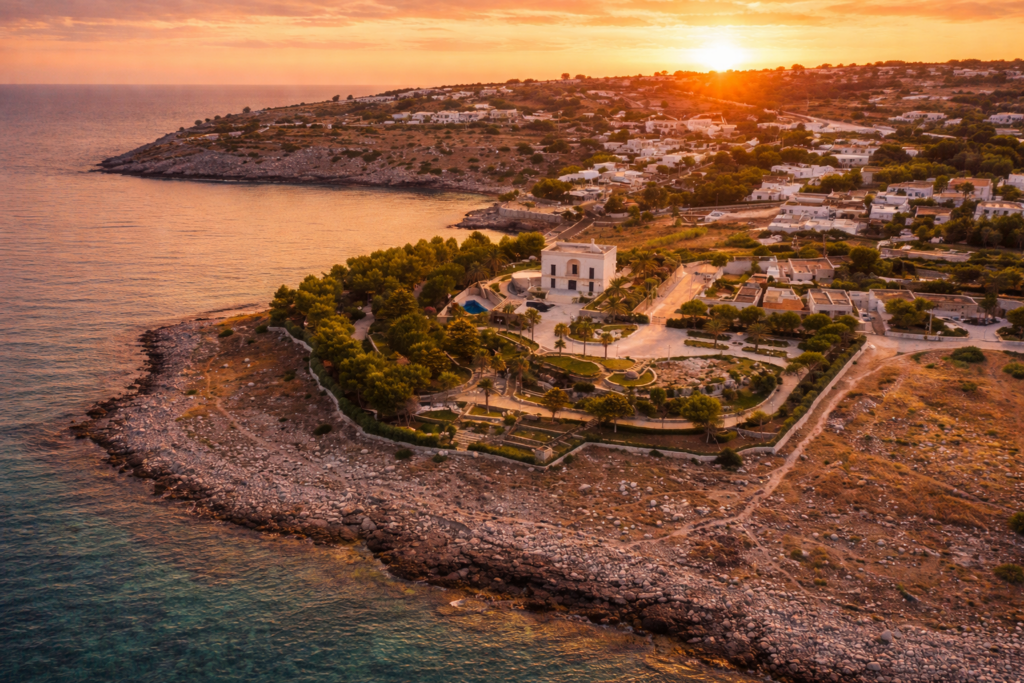
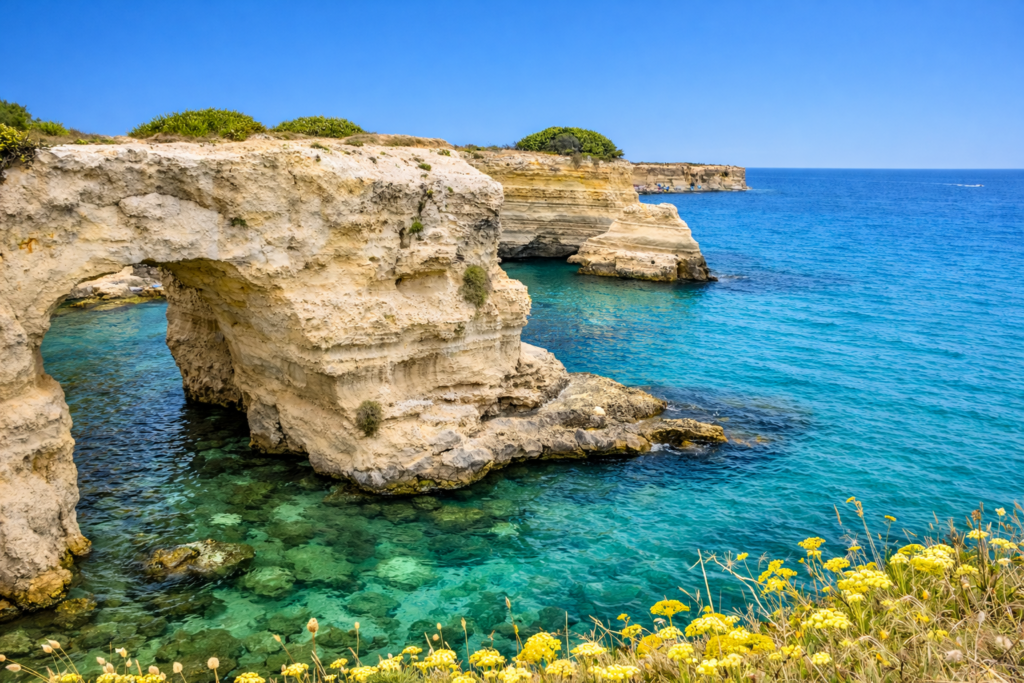
Patù is a municipality at the southernmost tip of the Capo di Leuca; it borders Castrignano del Capo to the north-east and the municipality of Morciano di Leuca to the west. The small town, one of the Borghi Autentici d’Italia (Authentic Villages of Italy), overlooks the Ionian Sea and includes Marina di San Gregorio and Marina di Felloniche.
Patù has very ancient origins and stands on the ruins of the ancient Messapian city of Veretum. The present-day town began to take shape after the city was destroyed by the Saracens. The invasion, which took place in 877, was repelled thanks to the mighty army sent by Charles the Bald, King of France. Some survivors of ancient Vereto moved down into the valley, thus forming the first permanent settlement. The actual town, however, developed during the Early Middle Ages and was consolidated in the feudal era. Over time, the area was ruled by various families: in the 14th century by the Sambiasi, followed by the Capece and the De Electis. Patù also belonged to the episcopal curia of Alessano and later to the Prince of Aragon of Cassano, before passing to the Guarino family and, finally, to the Granafei.
The origin of the name
The town’s name is thought to derive from the Greek pathos, meaning pain or suffering, a term that would recall the hardships endured by the people of Vereto when the ancient city was destroyed. Other theories instead link the place name to an ancient granary where the people of Vereto stored their provisions, entrusted to a keeper named Verduro Pato. Over time, and under the influence of the French form of the name, Pato is said to have taken on its present form, Patù.
Places of interest
Vereto
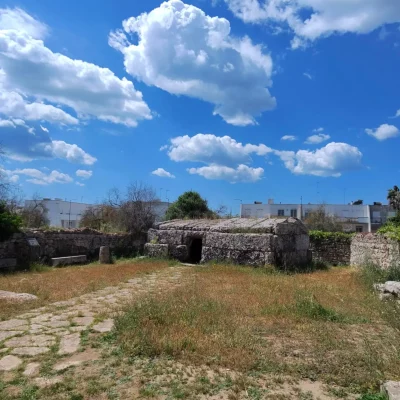
The town is best known for the remains of Vereto, which today form an archaeological site of great historical and cultural importance. In its day the Messapian city was one of the most important trading centres of Magna Graecia. Trade with nearby Greece led its inhabitants to build a small harbour, whose remains can still be seen on the seabed of the nearby bay of San Gregorio. Before being razed to the ground by the Saracens, ancient Vereto had also been a Roman municipium. Most scholars agree that the site now occupied by the small church of the Madonna di Vereto was once the acropolis, the heart of Messapian Vereto, and also the hub of the city in Roman and medieval times. Monumental remains can still be admired today, such as the foundations of the walls that encircled the city and various traces of the burial sites used at the time.
Centopietre
The best known of these is Centopietre, an ancient funerary monument standing opposite the Church of San Giovanni Battista, made of 100 (now 99) squared blocks of limestone taken from the Messapian city of Vereto and built as a mausoleum in honour of General Geminiano, a messenger of peace slain by the Saracens. Long forgotten, the monument began to attract the attention of scholars in the 19th century. It was later declared a second-class national monument. The ancient mausoleum is rectangular, with a gabled roof. Inside, the remains of frescoes depicting thirteen Eastern saints standing upright and facing forward can still be glimpsed, evidence that the monument was turned into a church in the Middle Ages. Unfortunately, most of the paintings in the monument have been almost entirely erased by damp.
Church of San Giovanni Battista
Opposite the funerary monument stands the Church of San Giovanni Battista. The building dates back to the 6th century; according to an anonymous document published in Padua in 1588, the church was built following the battle of Campo Re, near Patù. Its construction therefore coincides with that of the Centopietre funerary monument and with the moment in history when Charlemagne defeated the Saracens occupying Vereto. The building is made largely of megaliths of calcarenite stone (tufa) and must originally have been very similar to the nearby Church of Sant’Eufemia in Specchia. Restored several times over the centuries, the interior has three naves divided by rectangular pillars supporting round arches. Several single-lancet windows let light in, illuminating the church naturally. Inside the church some frescoes also survive, only a few of which depict San Giovanni Battista, the saint after whom the church is named.
Mother Church of San Michele Arcangelo
Francesco Centolanze was the architect who designed the Mother Church of San Michele Arcangelo, patron saint of Patù. Together with Palazzo Romano, this church gives the town’s small historic centre an evocative and picturesque atmosphere, typical of small Salento villages. The building has a single nave and, besides the high altar, houses four small side altars dedicated to San Michele Arcangelo, San Francesco d’Assisi, the Madonna del Rosario and the Madonna del Carmine. Next to the high altar is a wooden statue of the patron saint, which is carried in procession through the streets during the patronal feast held every year on 29 September. The Mother Church also houses an organ dating from 1723. The instrument, with a façade of 45 pipes, has recently been restored and stands in the choir loft above the entrance door. The Mother Church is flanked by a tall square bell tower, built in the 1940s and fitted with 5 bells, the oldest of which dates from 1752 and bears the figure of San Michele on horseback piercing a dragon with a spear, as well as San Giovanni Battista and the Madonna. The most recent bell, on the other hand, bears the coat of arms of Patù and once again the images of San Giovanni Battista and San Michele.
Church of the Madonna di Vereto
Religion and the historical events that led to the creation of this small village meet metaphorically in the little Church of the Madonna di Vereto, built in the 17th century at the behest of Prince Zunica, lord of Alessano. The church has no particular decorative features. The façade is simple, but inside it holds an extraordinary fresco of Saint Paul the Apostle. This is an important work that adds to the Pauline iconography found throughout Salento. The fresco in the little church shows the saint in a solemn, menacing pose with his traditional attribute, the sword, around which two serpents are coiled. At the saint’s feet is a bestiary featuring a spider, a scorpion, a snake and two snakes intertwined in a caduceus. What makes the fresco so interesting is its implicit reference to tarantism, one of the cornerstones of Salento folklore. Over the years the little church also served as a burial place, as shown by the discovery of the remains of two graves dug into the ground near the apse of the old church.
Crypt of Sant’Elia
Little known but extraordinarily beautiful, the Crypt of Sant’Elia is a rock-cut church carved into the stone, dating from the 8th–9th century and located a few metres from the road leading to the hamlet of San Gregorio. It is entered through a small opening leading to an intimate underground space with simple architecture: an altar hewn directly from the rock and a bench carved along the walls. The atmosphere is that typical of rock-cut places of worship, simple and austere spaces designed for prayer. Although the frescoes are now badly deteriorated, traces of Byzantine-era paintings can still be made out on the walls, depicting figures of saints and probably an image of Christ. These remains confirm the religious function of the small crypt and the site’s link with the iconographic tradition of the Christian East, deeply rooted in medieval southern Salento. Today the crypt retains a special charm: it bears witness to the area’s rock-cut past and to the spiritual history of Patù and ancient Vereto.
Itineraries in Patù
Four routes on foot or by bike, taking in history, archaeology, landscape and coast.