Morciano di Leuca
Morciano di Leuca is an Italian municipality in the south of the Salento peninsula. It lies about 70 km south of the provincial capital and 9 km north of the very tip of Italy’s heel, Santa Maria di Leuca.
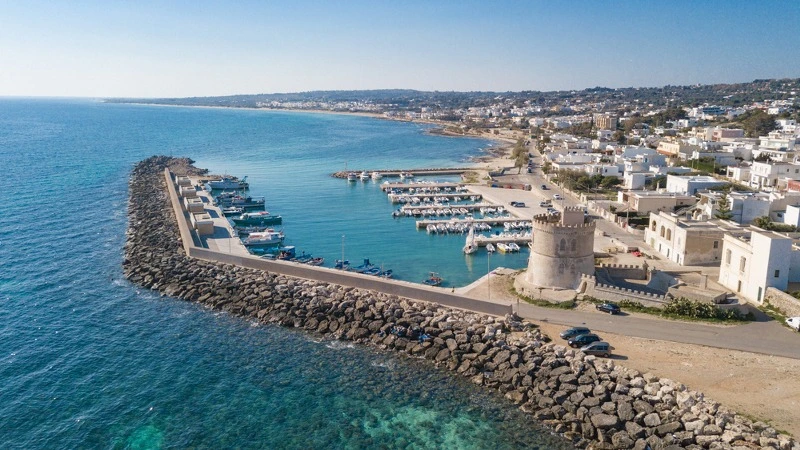
The Municipality, part of the Unione dei Comuni di Terra di Leuca, includes the hamlets of Barbarano del Capo and Marina di Torre Vado.
Like most of Puglia and the Salento municipalities, Morciano di Leuca has very ancient origins. The site appears to date back to prehistory, specifically to the Palaeolithic; the first settlement of Morciano di Leuca, however, dates from the 9th century, founded by refugees who took shelter in the countryside near the city of Vereto, destroyed by Saracen raids. The oldest part of the settlement at that time lay in the area where the old castle was built in the 16th century. In the Norman period, in 1190, the fief of Morciano di Leuca was granted by Tancredi d’Altavilla, the Norman ruler and then Count of Lecce, to Sinibaldo Sambiasi, whose descendants held it until the 13th century. Over time it then passed to Riccardus Murchano, a man probably of Angevin origin. The fief of Morciano changed hands several more times in later history – passing first, in 1316, into the estate of Guiscardo Sangiorgio, then a few decades later being sold to Walter VI of Brienne, until a few centuries later, in 1642, it came into the hands of the Castromediano family and finally, in 1848, into those of Giuseppe Valentini, who bought it for 2,200 ducats.
The origin of the name
The name Morciano di Leuca probably derives from the Latin “murex”, the rock known as “Murgia” that makes up the ground on which the town stands. Other theories suggest that the name may also refer to the Latin personal name Murcius or that it indicates that the place was once used for storing goods.
Places of interest
Mother Church of San Giovanni Elemosiniere
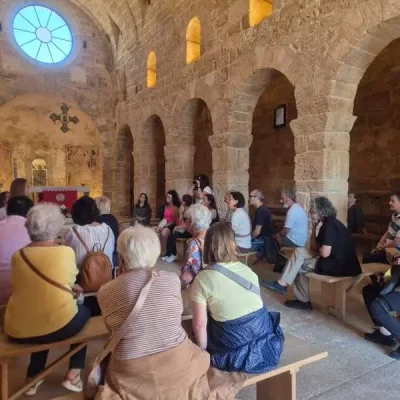
In Morciano di Leuca, history, tradition and culture have been intertwined with religious faith since the earliest times. From the Middle Ages to the 16th century, several churches were built in the town, becoming places of devotion and gathering for the whole community. The Mother Church of San Giovanni Elemosiniere dates from the late Middle Ages. It is an important Romanesque building with Baroque elements, especially in the entrance portal. Inside are three naves divided by pillars; the side naves in particular house characteristic altars in Lecce stone topped by 17th-century statues and canvases. Of great artistic value is the apse vault, where recent studies have brought to light frescoes depicting the Virgin and Child and San Michele Arcangelo. In the area in front of the building numerous graves have been found, probably forming an ancient necropolis dating from the 13th to the 14th century.
Church of the Carmine
From roughly the same period is the Church of the Carmine, also known as the Church of the Rosary, seat of the confraternity of the same name. The church was part of a single complex together with the Carmelite Convent, now destroyed. It was built in 1486 at the behest of the Baron of Morciano, Ruggero Sambiasi, as shown by the Latin inscription carved in stone on the coat of arms of the Sambiasi family:
“HOC EQUES AURATUS ROGERIUS ILLE SACELLUM BLASIA SANCTA DOMUS DAT TIBI VIRGO PARENS”
“The knight Rugero of the House of Sambiasi gives this Church to you, Virgin Mother”.
The entrance portal, topped by a frieze depicting the Annunciation, leads into the interior, which has a single nave marked by a series of arches containing 17th-century canvases and Baroque altars. Inside the church there is an organ, as well as papier-mâché and wooden statues from different periods.
Chapel of the Madonna di Costantinopoli
A small and precious religious gem is the Chapel of the Madonna di Costantinopoli, dating from the second half of the 16th century and one of the buildings erected after the Battle of Lepanto, fought in 1571 between the Turks and the main Catholic powers of the western Mediterranean: victory in the battle saved Christendom from Islamic expansionism, preventing a repeat of the fall of Constantinople into Turkish hands. Having saved the world from final catastrophe, the Virgin of Constantinople had to be honoured with shrines, chapels, buildings and altars consecrated to the Madonna who came from the East. What makes the little church in Morciano di Leuca unique is the presence of a large monolith (a menhir in local marble stone) on which a Madonna and Child is frescoed. The fresco, painted in colours dating from the period of Byzantine art, which blend naturally with the stone of the little church, bears the marks of a time rooted in the prehistoric religiosity of the Messapian period in Salento.
Underground olive presses
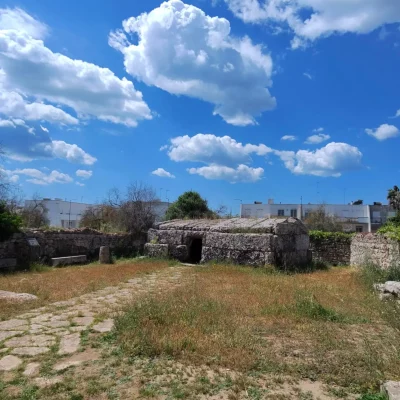
Morciano di Leuca also holds hidden treasures of extraordinary beauty. Numerous underground olive presses (as many as 18 in the historic centre alone) show how important olive oil culture was in this small Salento town. Many of these presses date from the 19th century, most of them created by breaking through granaries of Messapian origin. These archaic structures bear witness to the importance agriculture already had at that time, but not only that: they also show the ability of the area’s ancient inhabitants to exploit the land and the resources it offered. Most of the presses running beneath Morciano di Leuca are privately owned: the only one owned by the Municipality is the press that partly occupies the basements of Piazza San Giovanni, near the column dedicated to the town’s patron saint.
Castromediano–Valentini Castle
Evidence of the settlement’s medieval origins is the Castromediano – Valentini Castle, commissioned by Walter VI of Brienne in the mid-14th century to halt the expansionist ambitions of Francesco della Ratta, who had married into a family of counts living in nearby Alessano. The castle’s present name refers to the last families who lived there between the 17th and 19th centuries. It rises with its tall three-storey cylindrical tower, as if keeping watch over the whole community. The military character of the structure can be seen in the details of its architecture. The plan is quadrangular and was once reinforced at the corners by four round towers, only one of which is visible today; over time, in fact, the castle underwent various alterations to make room not only for the Carmelite Convent, founded by Baron Rodolfo Sanbiasi, but also for the Church of the Carmine, likewise belonging to the Carmelite Fathers, to be built against it. Arrow slits made it possible to spot the enemy and strike with boiling oil, weapons or bombards while remaining under cover. Among the features of the old castle are the merlons bearing the French fleur-de-lis that run along the entire crowning curtain wall, and the defensive portal surmounted by five noble coats of arms serving as ornaments. Beyond the main door lies an inner courtyard with several large rooms, once used as stables, kitchens, workshops, craft shops and armouries. A grand staircase on the right-hand side leads to the upper floors, occupied by what were once the guest quarters and the feudal lord’s rooms.
Itineraries in Morciano di Leuca
Five routes through the historic centre, the coast and the archaeological areas.